

 Back to News
January 26, 2026
First-Ever Suicide Prevention Town Hall Delivers Powerful Impact
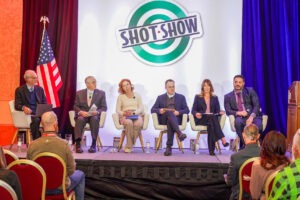
The 2026 SHOT Show® heralded the start of another year, setting the tone for business throughout its four-day run. But the show also provided a forum to address a more somber subject. For the first time, NSSF® presented a Suicide Prevention Town Hall, which featured a U.S. Cabinet Secretary and a panel of industry and suicide prevention experts.
For nearly a decade, NSSF has been working to help reduce suicide deaths among veterans and non-veterans. To heighten awareness around suicide prevention in the firearm community, NSSF has collaborated with the U.S. Department of Veterans Affairs (VA) and the American Foundation for Suicide Prevention (AFSP) and developed resources to equip individuals and organizations with knowledge to save lives.
A public Town Hall, held during the firearm industry’s biggest event, further illustrates NSSF’s commitment to raising awareness of this deeply sensitive topic. Town Hall attendees came away with two very important takeaways: Suicide is preventable, and everyone can do something to make a difference.
VA Secretary Asks Attendees: “Who’s Your One?”
Attendees had the opportunity to hear directly from a member of President Donald Trump’s Cabinet, VA Secretary Doug Collins, who delivered powerful remarks to open the session.
“This is personal for me. We take care of almost nine million veterans. Every day we’re doing something to make it better,” he said. “We can do more because every week I get a report on my phone that says another veteran chose death by suicide.”
According to statistics published by the VA, 17 American veterans die by suicide each day. Around 74 percent of suicides among male veterans involved a firearm.
Secretary Collins shared that the VA spends $588 million annually on suicide prevention. But even with this outlay, many veterans struggle without even being in touch with the VA. According to Secretary Collins, 60 percent of veterans who choose death by suicide were never in contact with the organization.
Because of this discrepancy, Secretary Collins shared the metrics defining a successful campaign must change — which has led to the VA revamping its suicide prevention program to make an impact.
“We failed the basic metric: is it actually reaching a veteran? Because if it’s not reaching a veteran, we’re not doing what we’re supposed to do,” he said.
Secretary Collins emphasized even small, intentional actions can have a profound, life-saving impact.
“I’m challenging each one of you to do whatever you can. It may be small. It may be big,” he said. “You may offer somebody a place to put a gun. You may offer somebody a place to just go have a cup of coffee. You may have a place where they can go out and go fishing or hunting. One is still here; one can make a difference.”
A Theme Continued
The theme of small actions can make the biggest impact continued when the panelists assembled onstage following the Secretary’s address.
NSSF President and CEO Joe Bartozzi led off the Town Hall segment by sharing how the topic of suicide prevention has become very personal to him and why it has made such a difference in his life. He urged those in attendance to get involved.
“My call to action today is to spread the word among your colleagues and peers, and help us do something,” he said. “NSSF has materials and resources — whatever you need, we will help you.”
Although business is front and center throughout SHOT Show, Bartozzi underscored the topic of suicide prevention impacts both business and personal relationships.
“There is a time when personal and business can coincide, and this is that time,” he said. “No one can do everything, but everyone can do something. There is something we can do together. Suicide is preventable.”
Science Makes a Clear Distinction
As an emergency physician and professor at the University of Colorado Anschutz, Dr. Emmy Betz regularly helps those who are in difficult moments.
“I’m proud to work with people and help them to hopefully get through those tough times,” she said. “But we also know a lot of people don’t seek care with us, and that’s why we need to be here — thinking about how we can reach broad audiences outside of hospital settings. We can’t always wait for people to ask for help.”
Dr. Betz shared, on average, half of Americans know someone who has died by suicide. Destigmatizing this topic is essential for bringing transformation.
“We’ve got to start talking about this more because it’s a very common experience, unfortunately, and it’s preventable,” she said.
Explaining the link between suicide and firearms, Dr. Betz noted the science makes a clear distinction.
“We know when a firearm is accessible to someone in crisis, the risk of death is much higher,” she said. “It’s not because guns make people suicidal. That’s not what the science tells us.”
Dr. Betz shared tips for helping someone — a customer, family member or friend — get through a high-risk period.
“A huge help is certainly reaching out and asking, ‘Hey what’s going on?’ and getting them help through the 988 Suicide Prevention Hotline. It’s free, 24/7 and an easy way to start,” she said.
Walking through the halls of The Venetian Expo and Caesars Forum during the SHOT Show, Dr. Betz noted the emphasis on secure storage options — which is critical for safety in the home and creating time and space for someone in the midst of crisis.
“I’m happy to see at the show this year a lot of emphasis on secure storage options. As we start to recognize that’s good for many reasons,” she said.
The Data Not Found on a Spreadsheet
Dr. Chris Barsotti is an ER physician at Berkshire Medical Center, in Pittsfield, Mass. Located in a rural area, it has a disproportionate rate of suicide — like other rural communities. Dr. Barsotti contended measuring suicide prevention is a difficult statistic to assess.
“We learn by understanding why people didn’t die. Prevention is hard to measure based on the tools we commonly use. ‘Nothing happened’ does not show up well on a spreadsheet,” he said. “When it comes to suicide, ‘nothing happened’ is the best possible outcome.”
Just talking about suicide will impact prevention, Dr. Barsotti asserted.
“Suicide is already being prevented, it’s just not being reported because it’s a non-event,” he said. “Living in a smaller community and talking about suicide, you hear stories about prevention. The more you hear, the more you begin to see there’s a pattern.”
The pattern Dr. Barsotti noted is the correlation between relationships with others and suicide. Connectedness is an effective deterrent to suicide.
“To prevent suicide, it’s the little things. You don’t need to fix everything. Like long-distance shooting, all it takes is a gust of wind to throw the round off its target,” he said. “Preventing suicide is exactly the same concept, inverted. What can be done to disrupt the shot? Do something small and completely unheroic. And that is the way that we can get the best possible outcome, which is ‘nothing happened.’”
A Worthy Endeavor
Jacquelyn Clark operates Bristlecone Shooting, Training & Retail Center, an NSSF Five-Star Range in Lakewood, Colo., and has partnered with Dr. Betz to prevent suicide through a variety of initiatives.
“Working with Dr. Betz, we have tried different secure storage options at my store, all with the common goal of normalizing secure storage and making it more accessible in the community. It allows people to put some time and space between very lethal means and going through a rough patch,” she said.
These efforts helped Clark and Dr. Betz establish a blueprint to take to other organizations, called Pause to Protect. It encourages individuals to pause, take a minute, create time and space and protect a life. This program fosters close connections between business owners, employees and their communities.
“We can help other ranges and retailers, FFLs and businesses all over the U.S. do the same type of work and see the same success of community engagement and gratification,” she said. “Programs like this have enabled me to create a better connection with my staff. They want to feel like they’re making a difference. And doing something like this in your community and taking care of the little things as a firearm business can create that engagement.”
Mirroring the sentiments of other panelists, Clark said it doesn’t have to be something extravagant to make an impression.
“I’m absolutely a testament to the fact small efforts can make an impact. If everybody’s doing a small effort using the vehicles that they have, we can make a difference,” she said.
Taking a Chance
Mike Sodini, founder of Walk The Talk America (WTTA), has a long relationship with the firearm industry, including a decades-long career in the firearm manufacturing space. Like other panelists, he has been deeply impacted by suicide and shared how it has affected his life.
“When you think about suicide, you always think there are signs — that you need to look for things,” he said. “And I want to caution everybody here, maybe that’s not the case all the time. It’s why it’s so important we tackle this ourselves as an industry, and we give tools and resources to our community.”
WTTA offers free, anonymous mental health screenings and has partnered with several firearm manufacturers to include a flyer with a free screening in firearm packaging. The positive reaction from customers surprised Sodini.
“When we think of guns and mental health, we usually think people are coming after our rights. But one of the coolest things, and the reason why I tell you this is because sometimes you’ve got to take a chance — sometimes you’ve got to just do something,” he said.
Sodini encouraged the firearm industry to continue its efforts to establish a leadership presence in this space.
“Talking about it doesn’t mean you’re going to inspire people to do it. They’re doing it,” he said. “The firearms industry can be the leaders in this space when it comes to suicide prevention and mental health. We don’t need any hero to save us. We can do it ourselves. And it starts by being creative.”
We Can All Do Something
During this impactful Town Hall, there was a consistent theme first presented by Secretary Collins and echoed by each of the panelists on stage: Everyone can make a difference, and everyone can do something to prevent suicide.
This public forum represents another way NSSF is providing the industry and the firearm-owning community resources to save lives. For more information on suicide prevention, check out NSSF’s “Have a Brave Conversation Toolkit.”
Categories: BP Item, Bullet Points, Featured, Top Stories, Veterans
25650