



|
The 10 Rules of Safe Gun Handling
Collapse All - Expand All
1. Always Keep The Muzzle Pointed In A Safe Direction
This is the most basic safety rule. If everyone handled a firearm
so carefully that the muzzle never pointed at something they didn't
intend to shoot, there would be virtually no firearms accidents.
It's as simple as that, and it's up to you.
Never point your gun at anything you do not intend to shoot. This
is particularly important when loading or unloading a firearm.
In the event of an accidental discharge, no injury can occur as
long as the muzzle is pointing in a safe direction.
A safe direction means a direction in which a bullet cannot possibly
strike anyone, taking into account possible ricochets and the fact
that bullets can penetrate walls and ceilings. The safe direction
may be "up" on some occasions or "down" on
others, but never at anyone or anything not intended as a target.
Even when "dry firing" with an unloaded gun, you should
never point the gun at an unsafe target.
Make it a habit to know exactly where the muzzle of your gun is pointing at all
times, and be sure that you are in control of the direction in which the muzzle
is pointing, even if you fall or stumble. This is your responsibility, and only
you can control it.
2. Firearms Should Be Unloaded When Not Actually In Use
Firearms should be loaded only when you are in the field or on
the target range or shooting area, ready to shoot. When not in
use, firearms and ammunition should be secured in a safe place,
separate from each other. It is your responsibility to prevent
children and unauthorized adults from gaining access to firearms
or ammunition.
Unload your gun as soon as you are finished. A loaded gun has
no place in or near a car, truck or building. Unload your gun immediately
when you have finished shooting, well before you bring it into
a car, camp or home.
Whenever you handle a firearm or hand it to someone, always open
the action immediately, and visually check the chamber, receiver
and magazine to be certain they do not contain any ammunition.
Always keep actions open when not in use. Never assume a gun is
unloaded -- check for yourself! This is considered a mark of an
experienced gun handler!
Never cross a fence, climb a tree or perform any awkward action
with a loaded gun. While in the field, there will be times when
common sense and the basic rules of firearms safety will require
you to unload your gun for maximum safety. Never pull or push a
loaded firearm toward yourself or another person. There is never
any excuse to carry a loaded gun in a scabbard, a holster not being
worn or a gun case. When in doubt, unload your gun!
3. Don't Rely On Your Gun's "Safety"
Treat every gun as though it can fire at any time. The "safety" on
any gun is a mechanical device which, like any such device, can
become inoperable at the worst possible time. Besides, by mistake,
the safety may be "off" when you think it is "on." The
safety serves as a supplement to proper gun handling but cannot
possibly serve as a substitute for common sense. You should never
handle a gun carelessly and assume that the gun won't fire just
because the "safety is on."
Never touch the trigger on a firearm until you actually intend
to shoot. Keep your fingers away from the trigger while loading
or unloading. Never pull the trigger on any firearm with the safety
on the "safe" position or anywhere in between "safe" and "fire." It
is possible that the gun can fire at any time, or even later when
you release the safety, without your ever touching the trigger
again.
Never place the safety in between positions, since half-safe is
unsafe. Keep the safety "on" until you are absolutely
ready to fire.
Regardless of the position of the safety, any blow or jar strong
enough to actuate the firing mechanism of a gun can cause it to
fire. This can happen even if the trigger is not touched, such
as when a gun is dropped. Never rest a loaded gun against any object
because there is always the possibility that it will be jarred
or slide from its position and fall with sufficient force to discharge.
The only time you can be absolutely certain that a gun cannot
fire is when the action is open and it is completely empty. Again,
never rely on your gun's safety. You and the safe gun handling
procedures you have learned are your gun's primary safeties.
4. Be Sure Of Your Target And What's Beyond It
No one can call a shot back. Once a gun fires, you have given up
all control over where the shot will go or what it will strike.
Don't shoot unless you know exactly what your shot is going to strike.
Be sure that your bullet will not injure anyone or anything beyond
your target.
Firing at a movement or a noise without being absolutely certain
of what you are shooting at constitutes disregard for the safety
of others. No target is so important that you cannot take the time
before you pull the trigger to be absolutely certain of your target
and where your shot will stop.
Be aware that even a .22 short bullet can travel over 1 ¼ miles
and a high velocity cartridge, such as a .30-06, can send its bullet
more than 3 miles. Shotgun pellets can travel 500 yards, and shotgun
slugs have a range of over half a mile.
You should keep in mind how far a bullet will travel if it misses
your intended target or ricochets in another direction.
5. Use Correct Ammunition
You must assume the serious responsibility of using only the correct
ammunition for your firearm. Read and heed all warnings, including
those that appear in the gun's instruction manual and on the ammunition
boxes.
Using improper or incorrect ammunition can destroy a gun and cause
serious personal injury. It only takes one cartridge of improper
caliber or gauge to wreck your gun, and only a second to check each
one as you load it. Be absolutely certain that the ammunition you
are using matches the specifications that are contained within the
gun's instruction manual and the manufacturer's markings on the
firearm.
Firearms are designed, manufactured and proof tested to standards
based upon those of factory loaded ammunition. Handloaded or reloaded
ammunition deviating from pressures generated by factory loads or
from component recommendations specified in reputable handloading
manuals can be dangerous, and can cause severe damage to guns and
serious injury to the shooter. Do not use improper reloads or ammunition
made of unknown components.
Ammunition that has become very wet or has been submerged in water
should be discarded in a safe manner. Do not spray oil or solvents
on ammunition or place ammunition in excessively lubricated firearms.
Poor ignition, unsatisfactory performance or damage to your firearm
and harm to yourself or others could result from using such ammunition.
Form the habit of examining every cartridge you put into your gun.
Never use damaged or substandard ammunition -- the money you save
is not worth the risk of possible injury or a ruined gun.
6. If Your Gun Fails To Fire When The Trigger Is Pulled, Handle With Care!
Occasionally, a cartridge may not fire when the trigger is pulled.
If this occurs, keep the muzzle pointed in a safe direction. Keep
your face away from the breech. Then, carefully open the action,
unload the firearm and dispose of the cartridge in a safe way.
Any time there is a cartridge in the chamber, your gun is loaded
and ready to fire even if you've tried to shoot and it did not
go off. It could go off at any time, so you must always remember
Rule No. 1 and watch that muzzle!
Discharging firearms in poorly ventilated areas, cleaning firearms
or handling ammunition may result in exposure to lead and other
substances known to cause birth defects, reproductive harm and
other serious physical injury. Have adequate ventilation at all
times. Wash hands thoroughly after exposure.
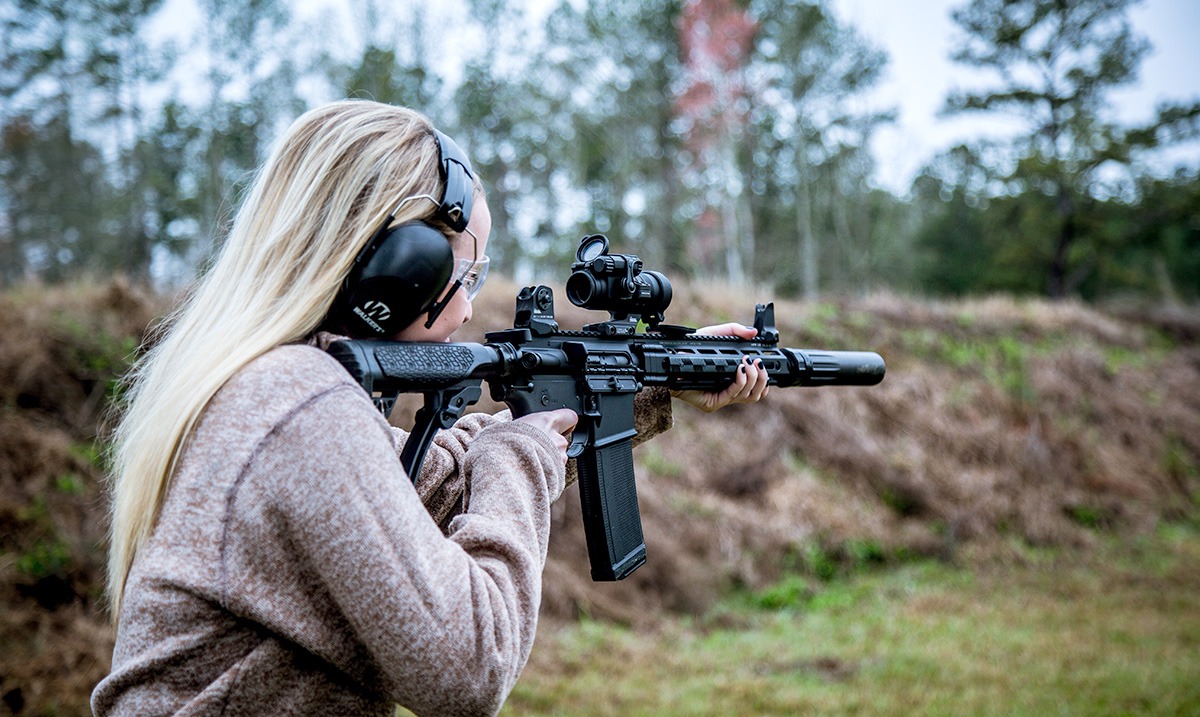
7. Always Wear Eye And Ear Protection When Shooting
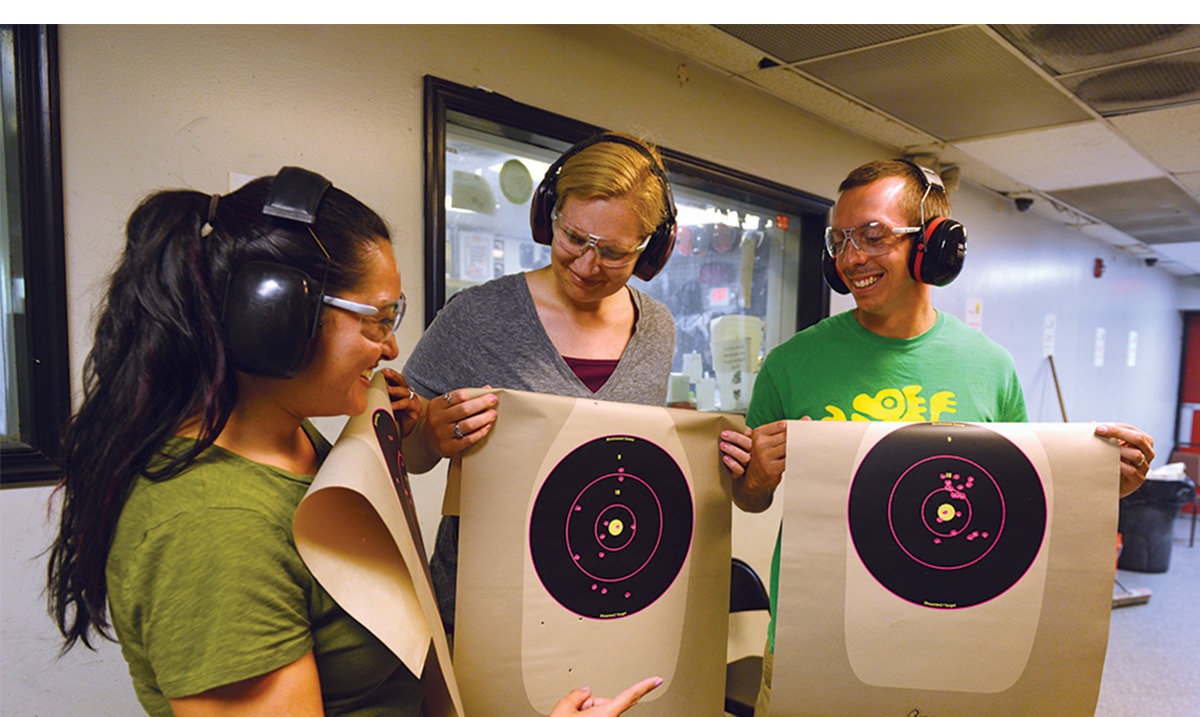
All shooters should wear protective shooting glasses and some
form of hearing protectors while shooting. Exposure to shooting
noise can damage hearing, and adequate vision protection is essential.
Shooting glasses guard against twigs, falling shot, clay target
chips and the rare ruptured case or firearm malfunction. Wearing
eye protection when disassembling and cleaning any gun will also
help prevent the possibility of springs, spring tension variety
of eye and ear protectors available. No target shooter, plinker
or hunter should ever be without them.
Most rules of shooting safety are intended to protect you and
others parts, solvents or other agents from contacting your eyes.
There is a wide around you, but this rule is for your protection
alone. Furthermore, having your hearing and eyes protected will
make your shooting easier and will help improve your enjoyment
of the shooting sports.
8. Be Sure The Barrel Is Clear Of Obstructions Before Shooting
Before you load your firearm, open the action and be certain that
no ammunition is in the chamber or magazine. Be sure the barrel
is clear of any obstruction. Even a small bit of mud, snow, excess
lubricating oil or grease in the bore can cause dangerously increased
pressures, causing the barrel to bulge or even burst on firing,
which can cause injury to the shooter and bystanders. Make it a
habit to clean the bore and check for obstructions with a cleaning
rod immediately before you shoot it. If the noise or recoil on
firing seems weak or doesn't seem quite "right," cease
firing immediately and be sure to check that no obstruction or
projectile has become lodged in the barrel.
Placing a smaller gauge or caliber cartridge into a gun (such
as a 20-gauge shell in a 12-gauge shotgun) can result in the smaller
cartridge falling into the barrel and acting as a bore obstruction
when a cartridge of proper size is fired. This can cause a burst
barrel or worse. This is really a case where "haste makes
waste." You can easily avoid this type of accident by paying close attention
to each cartridge you insert into your firearm.
9. Don't Alter Or Modify Your Gun, And Have Guns Serviced Regularly
Firearms are complicated mechanisms that are designed by experts
to function properly in their original condition. Any alteration
or change made to a firearm after manufacture can make the gun
dangerous and will usually void any factory warranties. Do not
jeopardize your safety or the safety of others by altering the
trigger, safety or other mechanism of any firearm or allowing unqualified
persons to repair or modify a gun. You'll usually ruin an expensive
gun. Don't do it!
Your gun is a mechanical device that will not last forever and
is subject to wear. As such, it requires periodic inspection, adjustment
and service. Check with the manufacturer of your firearm for recommended
servicing.
10. Learn The Mechanical And Handling Characteristics Of The Firearm You Are Using
Not all firearms are the same. The method of carrying and handling
firearms varies in accordance with the mechanical characteristics
of each gun. Since guns can be so different, never handle any firearm
without first having thoroughly familiarized yourself with the
particular type of firearm you are using, the safe gun handling
rules for loading, unloading, carrying and handling that firearm,
and the rules of safe gun handling in general.
For example, many handgun manufacturers recommend that their handguns
always be carried with the hammer down on an empty chamber. This
is particularly true for older single-action revolvers, but applies
equally to some double-action revolvers or semiautomatic pistols.
You should always read and refer to the instruction manual you
received with your gun, or if you have misplaced the manual, simply
contact the manufacturer for a free copy.
Having a gun in your possession is a full-time job. You cannot
guess; you cannot forget. You must know how to use, handle and
store your firearm safely. Do not use any firearm without having
a complete understanding of its particular characteristics and
safe use. There is no such thing as a foolproof gun.
Hunting and target shooting are among the safest of all sports. This
Web site is intended to make them even safer by emphasizing the basics
of safe gun handling and storage and by reminding you that you are the
key to firearms safety.
You can help meet this responsibility by enrolling in hunter safety
or shooting safety courses. You must constantly stress safety when handling
firearms, especially to children and non-shooters. Beginners, in particular,
must be closely supervised when handling firearms with which they may
not be acquainted.
Don't be timid when it comes to gun safety. If you observe anyone violating
any safety precautions, you have an obligation to insist on safer handling
practices, such as those on this Web site.
Please click the links above and follow the safety procedures outlined.
Develop safe shooting habits, and remember, firearms safety is up to
you.
MAKE NO MISTAKE ABOUT IT!
|
|